
In commemoration of Sabah Day and Merdeka Day, and ahead of Malaysia Day, an anonymous member of GEGAR writes about the role of grassroots activism in the long and unfinished struggle for our freedom.
Tunku Abdul Rahman standing in Stadium Merdeka, proudly declaring Malaya’s independence to a cheering crowd; this is the image every Malaysian pictures on Hari Merdeka, or at least what the ruling class wants us to see.
Though important, this picture-esque scene barely scratches the surface. The widespread narrative of a smooth, elite-led fight for independence overlooks the people-led strikes and mass protests that forced the British to the negotiation table. Independence did not come out of thin air, obviously, but neither did it come from pleasant talks and peaceful negotiations.
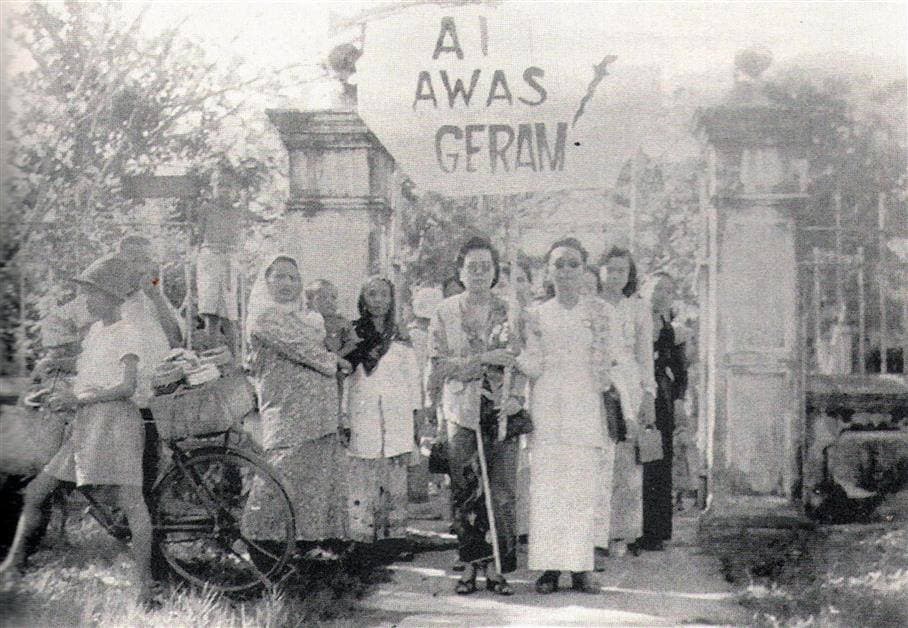
For decades, before a Hari Merdeka could even be conjured up in the wildest of dreams, activists laid the groundwork for it. Long before mainstream political parties began the legal transition of power, it was activists who dared to imagine a Malaya that was completely free. Early radicals built the foundations of our independence from scratch and sedition. Political organisers like S.A. Ganapathy spoke directly to labourers; rubber tappers and dockworkers alike, fighting the “divide and rule” strategy by uniting workers across ethnic lines. In his efforts, he built the Pan Malayan Federation of Trade Unions (PMFTU), which fought for both workers’ rights, and the larger battle for independence from imperialist control.
When amicable persuasion failed to move a violent colonial administration, the people demonstrated their power through disruptive actions that directly hit the imperialists where it hurt: the 1947 Hartal, a peninsular-wide shutdown that cost the colony over 4 million British pounds in merely a single day. Workers across Malaya participated in a coordinated strike; whether through petitions, writings or mass action, they turned sentiments into actions.
Meanwhile, elitist Malaya-centric narratives neglect the rich legacy of people-led resistance in Borneo: long before Malaysia was formed, activists in Sabah, Sarawak, and Brunei had already been fighting for a free and unified Borneo. Indigenous movements like the United Pasok Momogun organised thousands in demanding the sovereignty of Indigenous people in Sabah. Not long after Malaya's independence in 1957, mass movements in Sabah, Sarawak, and Brunei petitioned for a unified Borneo to the United Nations in 1962, building an alternate geopolitical reality that threatened Empire.
Meanwhile, in Sarawak, mass protests and demonstrations gripped the streets with demands of independence and self-determination. Workers, farmers, students, and Indigenous people of all races marched to oppose British colonial rule and the planned merger of Sarawak with Malaya. When petitions and memoranda fell on deaf ears, the people of Sarawak took up arms as they did in Malaya, bringing the empire to a halt.
It was these tangible disruptions, not nicely minced words, that forced Britain to the negotiation table. It was the combination of economic non-cooperation and an economically exhaustive guerrilla war made the occupation of Malaya and Borneo financially and politically unsustainable.
Though forced to fast-track our independence, the British colonial administration exercised its ultimate wildcard by intentionally bypassing the radical left, instead choosing to negotiate exclusively with moderate-conservative elites. In Malaya, this meant a direct transfer of power to the right-wing aristocracy and bourgeois elites. In Sabah and Sarawak, this meant the forced merger of Sabah and Sarawak with Malaya by the Cobold Commission, against the wishes and self-determination of its Indigenous people.
By retaining influence over who would inherit power after its departure, Britain effectively guaranteed that Malaysia would remain as a capitalist ally, even as a politically independent nation. Consequently, the legal negotiations that led to the eventual independence of Malaya on 31st August 1957, the independence of Sabah and Sarawak in 1962, and formation of Malaysia in 1963, did not happen in a political vacuum; they acted to preserve the status quo for elite interests.
This reality serves as a powerful reminder that as we commemorate our formal independence, freedom is not a static milestone, but a continuous journey. Even the independence we celebrate today was engineered to protect systemic privileges and keep us working as cogs of an imperialist machine.
The declaration of Merdeka was never a signal to end the fight. The very spirit of grassroots organising and relentless activism that originally forced the empire to its knees remains the exact force necessary today to a future of true liberation.