
In commemoration of the 79th anniversary of the All-Malaya Hartal on 20th October 1947, an anonymous member of GEGAR writes about the importance of reclaiming our labour power in times of hopelessness and imperialist domination.
As modern workers, it is easy to feel completely isolated. Whether you are a barista grinding through the morning rush, or a corporate worker staring at your inbox in a sterile office, the feeling that you are disposable is constant. As wages remain stagnant and the cost of living rises, the rise of AI and frequent layoffs is also keeping this fear fresh.
Meanwhile, we are living through an unprecedented crisis in the global system of capitalism and imperialism. Genocides in the Congo, Palestine, and Sudan, at the hands of the Zioimperialist war machine and corporations, are live-streamed on our phones. Our forests are being burned down and our air is choked by capitalist extraction. The U.S. imperialist assault on Iran is driving food shortages and rising costs of living.
The narrative sold by the ruling class that we are disposable is nothing new, but most importantly, it is untrue.
79 years ago today, the working class of Malaya faced the exact same systemic challenge. Viewed as nothing but cogs in an imperialist extraction machine by the British empire, the working masses of Malaya stood on the brink of being stripped completely of their political agency and economic voice, through the imposition of the undemocratic Federation of Malaya Constitutional Proposals. The constitutional proposals would have centralized all political power in the hands of the British, robbing the local rulers of their sovereignty and fortifying the exploitation of our people and maximum extraction of our land.
Rather accepting this cruel new system, the workers of 1947 had the courage to imagine a better world. Recognizing the importance of political consciousness, especially among the exploited, and left wing coalitions such as PUTRA and AMCJA educated the masses across cities, villages, towns and plantations. Local community leaders and activists were deployed within their respective communities to engage in direct dialogue with everyday workers. These representatives explained how the struggle against the British was tied directly to the livelihood of all Malayans. Leading up to the strike, the alliance also distributed 400,000 printed copies of the Hartal Manifesto, detailing their demands.
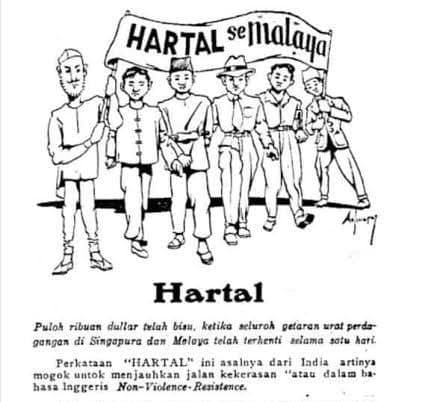
On October 20th, 1947, those very workers rejected this state-enforced narrative of powerlessness. They mobilized across ethnic lines to execute a historic nationwide general strike, the All-Malaya Hartal 1947. For just one single day, from the shipping ports to local shops, everything stood still. In a span of just twenty-four hours, this collective withdrawal of labor halted the colonial economy, losing the British colonial government an estimated 4 million pounds in revenue. That day proved a fundamental truth that we desperately need to remember today: capital is absolutely nothing without labor. Today, the elites may own the buildings, the machinery and the corporations, but they are nothing without the workers.
The British's imperial extraction relied entirely on the compliance of the labour force. And when they stopped complying, the effects were felt through the nation.
Our current economy relies on this same compliance. Instead of tin mines or rubber estates, we are giving away our rare earth minerals to imperialist countries to build their jets and bombs. We are selling off our precious land and water to power the cloud infrastructure of the Zionist war machine. We service US warships on their way to bomb schoolchildren and provide the logistics that enable the imperialist arms supply chain to function. And our compliance allows this war machine to keep destroying. But if we unite and withdraw our support, through labour strikes and targeted boycotts, we take back our power, and choke the imperialist wealth extraction pipeline.
Though we may no longer have British governors directly calling the shots, or soldiers patrolling plantations, our economy still acts to serve the interest of Western powers. This is known as neocolonialism; the control of a state by another through indirect means.
Fortified institutions like the IMF and World Bank play a huge role in keeping formerly colonized countries underdeveloped. They force these nations into disadvantageous deals, trapping them into debt and rendering them unable to fully recover from their colonized past. This ensures the dependence of developing nations on the Western superpowers, coercing them to prioritize foreign interests over that of their citizens. Meanwhile, imperialist superpowers such as the U.S. act as the global police, using deadly sanctions, blockades, and military invasion to punish any country that dares to resist Western economic control, whether that be Palestine, Iran, Cuba, and Venezuela.
One of the biggest manifestations of neocolonialism in our age is the exploitation of labour, such as workers in sweatshops in the global south, where massive profits are extracted while workers earn next to nothing, and are even left to die in unsafe working conditions. In Malaysia, we also see this playbook in the recent boom of data centers. By embedding the physical infrastructure of the AI race on Malaysian soil, corporations offload the liabilities, risks, harm and accountability to locals; the ugly, noisy side of AI development is left here. This affects the non-consenting residents' health and well-being, while the responsible tech conglomerates are removed completely from the equation, all while they swim in astronomical profits.
While the powers have become faceless, and the names changed, the fundamental mechanism of exploitation remains the same. From colonial governments to multinational tech conglomerates, we as the people will always hold collective power. Hence why breaking this exploitative cycle requires the same solidarity and radical unity that drove the Hartal in 1947.
Conclusion
Coordinated across diverse coalitions, the fighters all shared one collective aim: freeing the country from the British. They did not want to simply stop at ending the constitutional proposals. The people dared to dream bigger, and though the movement is considered a failure by some, I beg to differ. The Hartal laid a foundation for class-solidarity, shattering our sense of powerlessness; showing us that our weakness rather comes from fractured class-consciousness. This lesson must be applied to fight against the injustices of today; by allowing ourselves to be divided we give up our power. We must look past artificial divisions drawn to keep us feeble. To honor the legacy of our ancestors is to rebuild our consciousness, stand together and demand an economy free from imperialist control. This dream may seem ridiculous at first, but I question whether that is true, or the result of conditioning.
To Malayans in 1947, an independent Malaya, Merdeka, seemed ridiculous; and now it is our most celebrated national achievement. So, why should it be considered absurd to conceive of an economic system built independently of the imperialist super powers, who are defined by our exploitation? It is important to ask questions, and think of solutions to our current predicament. However, we must not fall into imperialist-induced conditioning. We must actively resist surrendering our radical imagination for a truly equitable world in favor of an imperialist-informed "pragmatism" that serves only to maintain the power of those at the top.
20 OCTOBER 2026
GEGAR